
A kitchen remodel is one of the largest investments most homeowners make outside of buying the house itself. Ten to twenty weeks with a crew in your home. Decisions about money, design, and daily logistics piling up every week. The contractor you hire shapes every part of that experience.
Horror stories are easy to find. Projects that drag past their timeline by months. Unexpected costs that double the bid. Crews that show up for a few days and then disappear. These things happen, but they happen less often when homeowners know what to look for before signing a contract.
This guide is for anyone hiring a kitchen contractor in Durham, Chapel Hill, Hillsborough, or anywhere else in the Triangle. Twenty years of remodeling homes in this area has taught us what separates a good fit from a costly mistake.
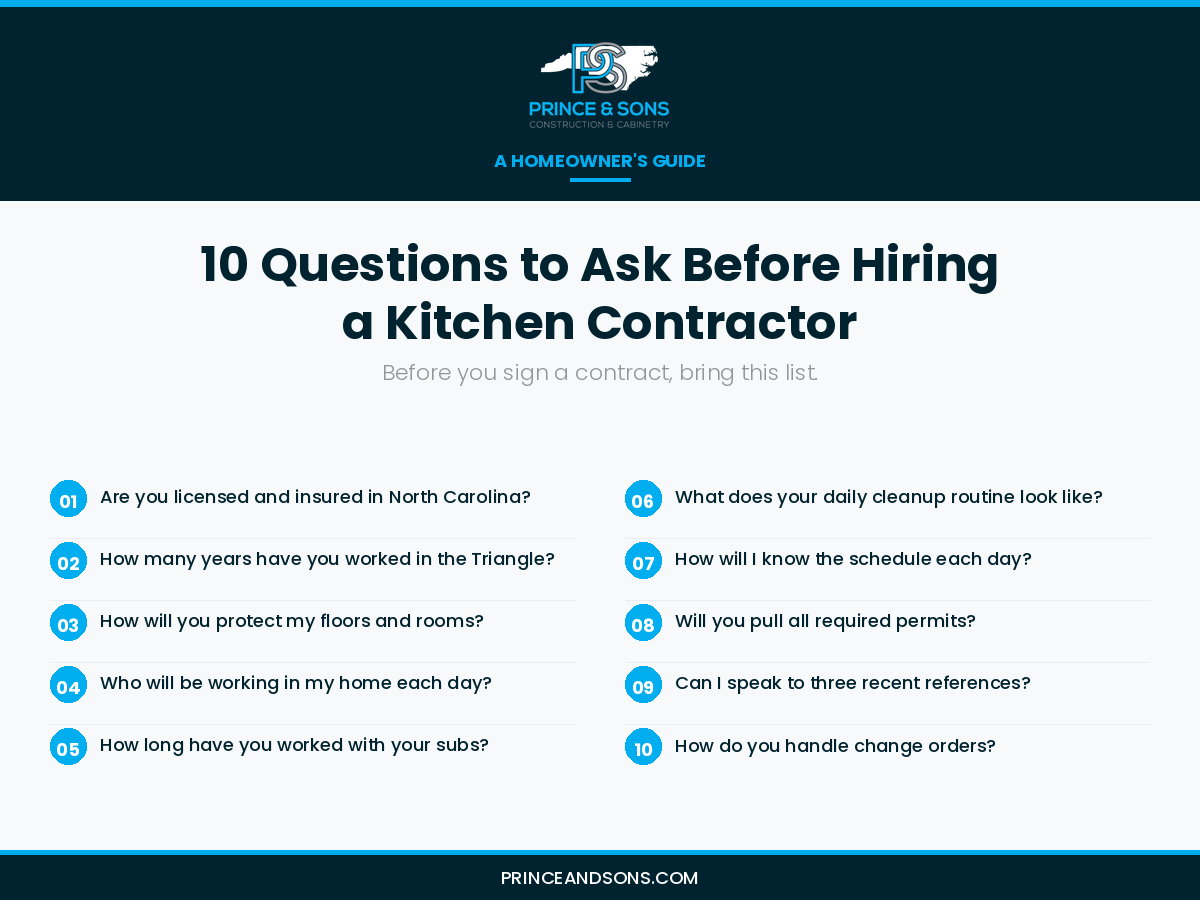
In North Carolina, any project over $40,000 (new in 2026, up from $30,000) requires a licensed general contractor. You can verify a license at the NC Licensing Board for General Contractors. Ask for the license number and check it yourself. It takes two minutes and tells you whether the person you’re talking to is legally allowed to run your project.
Insurance matters just as much. A reputable contractor carries general liability and workers’ compensation coverage. If a worker gets hurt on your property and the contractor doesn’t carry workers’ comp, that liability can land on you. Ask for certificates of insurance from the carrier directly, not a photocopy pulled from a folder.
Local matters for reasons that show up two or three years after the job is done. A Triangle-based contractor is still around when a cabinet door needs adjusting or a tile starts to crack. Out-of-town operations chase work and move on. Local contractors also know the Durham permitting office, the inspectors who cover Orange County, and the quirks of a 1960s Chapel Hill brick ranch versus a newer build in Cary.
A lot of contractors claim decades of experience. Dig into what that experience actually is. Someone who has been building houses for thirty years may have completed only a handful of kitchens. A shop that specializes in additions might not be the right fit for a gut renovation with custom cabinetry.
Ask direct questions. How many kitchens has the company finished in the past three years? Who designs the layout, and who manages the build? Is the owner involved in the project, or does it get handed off to a project manager you haven’t met? Family-owned shops tend to have tighter quality control because the name on the truck is the name on the contract. Larger outfits can move faster, sometimes at the cost of personal attention. Neither is automatically better. The question is which fits your project.
A kitchen remodel is a messy process. Sawdust travels. Drywall dust settles in places you didn’t know existed. The difference between a tolerable project and a miserable one often comes down to how the contractor sets up the site on day one.
Questions worth asking:
At Prince & Sons we treat every job site the way we’d treat our own house. Floors get covered from the entry point to the work area. Doorways get sealed. Tools go back in the trailer at the end of the day. The small stuff signals how an experienced general contractor thinks about the big stuff.

Most general contractors use subcontractors for plumbing, electrical, tile, drywall, and finish work. That’s normal, and often better than keeping specialized trades in-house. What matters is which subs they use.
Ask how long they’ve worked with their trade partners. A contractor who has used the same plumber for ten years has a plumber who shows up on time and does clean work, because that plumber wants to keep the relationship. Rotating through the cheapest available labor produces inconsistent results and more callbacks later.
Ask who will be in your house each day. Will the owner check in? Will the same crew be there from demo through finish, or will faces change every week? You are inviting these people into your home for two to three months. They should be respectful, communicative, and comfortable working around your daily life. Our trade partners have worked with us for years, and most of them have worked together long enough to read each other’s minds on a job site. That translates to fewer mistakes and less friction for the homeowner.
If a contractor takes four days to return your call when they’re trying to win your business, that is a preview of how they will communicate when the project hits a bump. Slow responses, vague answers, and shifting timelines during the estimate phase usually get worse once the work starts.
Good communication looks like written estimates with a defined scope, a named point of contact, and a real schedule. Not “we’ll probably start in April.” Actual dates.
Prince & Sons uses a cloud-based project calendar that homeowners can open from their phone. You can see who is coming, when, and what they are doing on any given day. No guessing. No surprise knocks at seven in the morning. You know if the electrician is on-site Tuesday and the tile guy starts Thursday.
A list of references is only useful if you actually call them. Ask the kind of questions that get honest answers:
Online reviews are worth reading too. Pay attention to how the contractor responds to criticism. A thoughtful reply to a negative review tells you more than ten glowing five-star posts.
Some warning signs come up over and over in contractor disputes:
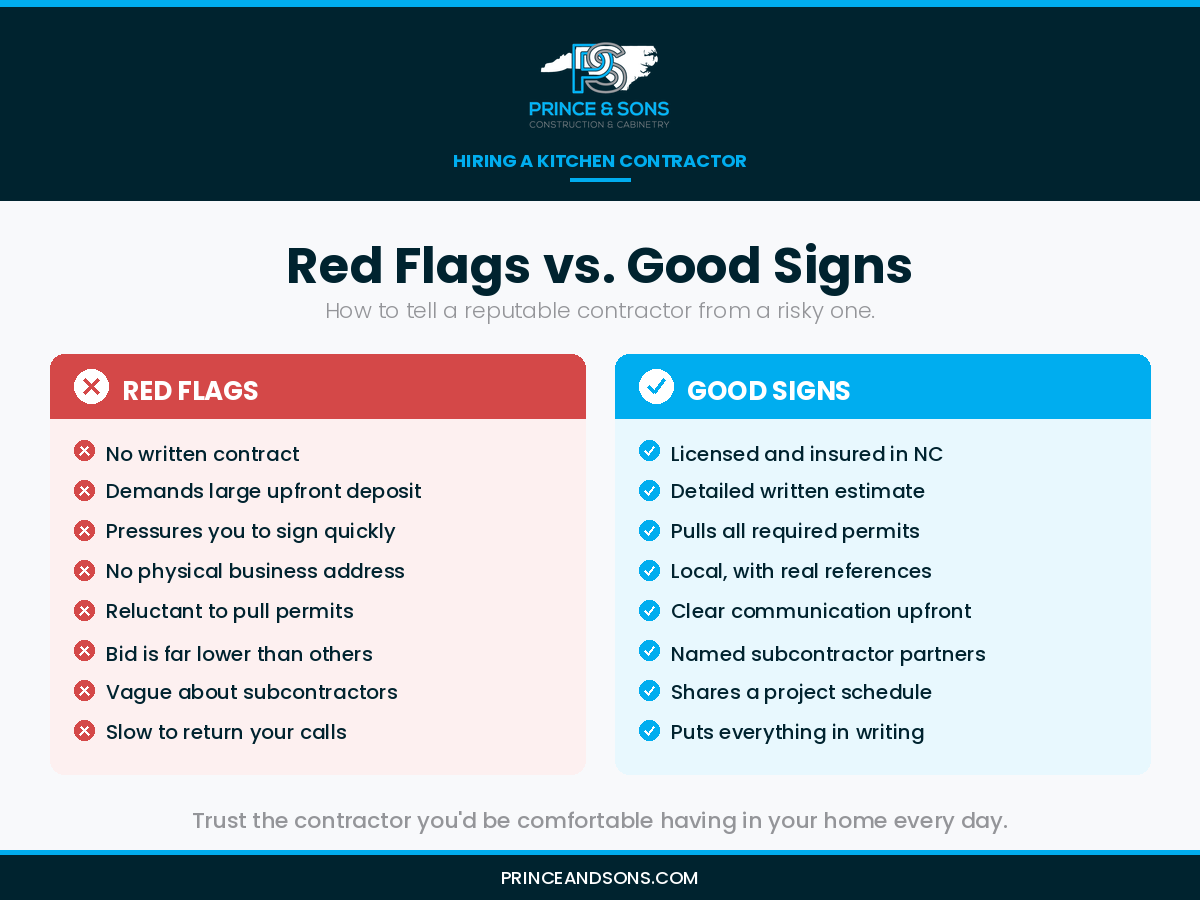
The cheapest bid almost never wins in the long run. Compare estimates line by line. A solid estimate includes:
If one bid comes in thousands of dollars lower than the others, look at what is missing. Cheap bids often skip demolition, disposal, electrical upgrades, or finish work. Those costs don’t disappear. They arrive later as change orders, and the homeowner pays them regardless.
Cabinetry is worth extra attention. The cabinet line a contractor recommends tells you a lot about their standards. Ask about the brand, the box construction, the drawer glides, and the warranty. A good contractor can explain the difference between a stock cabinet and a custom one without needing to consult a sales brochure.
After the first in-home consultation, you usually know whether this is someone you want in your house for the next few months. Did they listen to what you wanted? Did they answer questions directly, including the uncomfortable ones about cost and timeline? Did they show up when they said they would? Were they respectful of your space?
A good fit feels right before the contract is signed. A bad fit usually shows itself in the first hour.
If you are planning a kitchen remodel in Durham, Chapel Hill, Hillsborough, or anywhere else in the Triangle, we would be glad to walk through your project in person. No pressure, no high-energy pitch. Just an honest conversation about what you want, what it is likely to cost, and how long it should take. Feel free to fill out our online intake form that will allow us to better understand your project or just give us a call at 919-383-0888 if you’d rather talk to one of our team members by phone.